
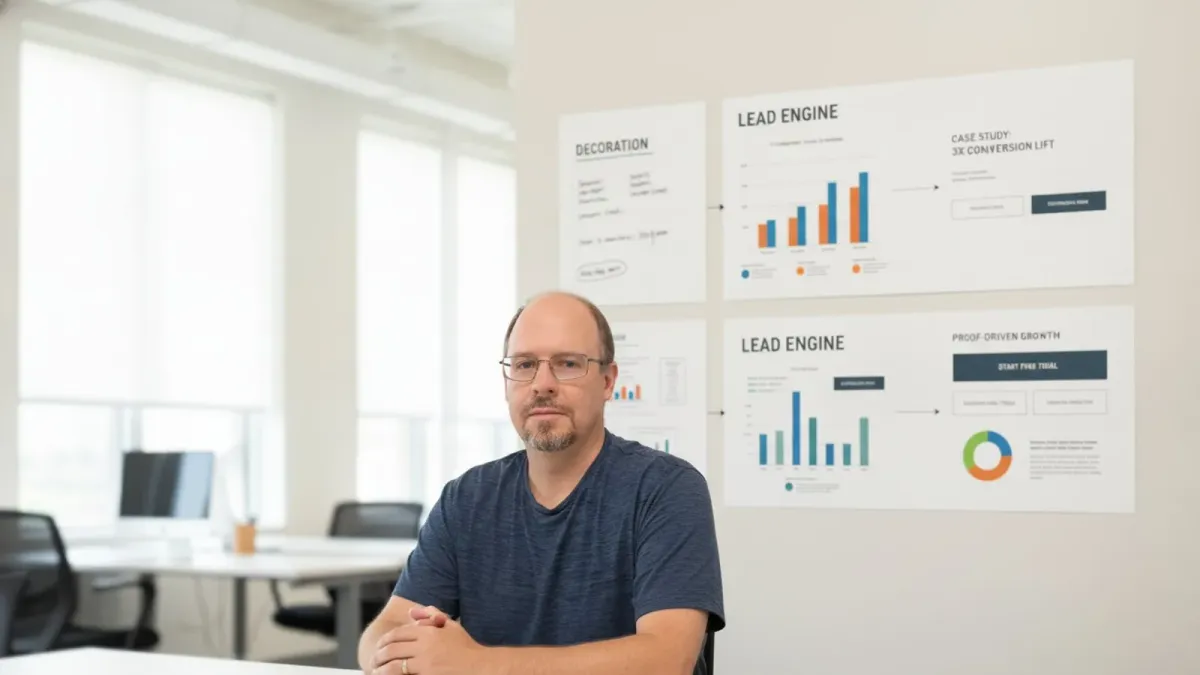
Most businesses treat case studies like decoration.
They publish a customer win, add a nice quote, maybe share it once on LinkedIn, and then let it disappear into the website footer. That wastes one of the strongest proof assets in your business.
If you want better-qualified leads, fewer skeptical sales calls, and a more predictable lead generation system, start using case studies for lead generation instead of treating them like passive credibility pieces.
Proof is one of the ten channels in the lead generation strategies guide, and it is the one that does the most work per hour spent — a single customer story can carry a search page, an email sequence, a sales call and a retargeting ad.
Key Takeaways
- Case studies for lead generation turn customer success stories into proof-based conversion assets.
- The best case studies focus on a specific customer, clear problem, measurable result, and one strong CTA.
- A lead-generating case study should connect directly to a conversion path like a template, audit, demo, or booked call.
- Most businesses should use a hybrid model: publish an ungated case study for SEO and offer a gated bonus asset for lead capture.
- One strong case study can be repurposed into social posts, emails, sales assets, webinar material, and retargeting ads.
- Track performance with page views, CTA clicks, opt-in rate, booked calls, pipeline influenced, and revenue influenced.
- A good case study does not just prove you can deliver. It helps prospects believe the same result is possible for them.
What Are Case Studies for Lead Generation?
Case studies for lead generation are customer success stories built to attract, educate, and convert prospects. They show a relatable problem, the solution used, the result achieved, and the next step a reader should take.
A regular case study says, “Here is what we did.”
A lead-generating case study says, “Here is how someone like you solved this problem, and here is how you can take the next step.”
Why Case Studies Generate Leads So Well
Case studies work because they turn marketing claims into believable proof.
If you say you help clients generate leads, improve conversion rates, or reduce wasted ad spend, prospects will naturally be skeptical. A case study removes guesswork by showing who had the problem, what changed, and what happened next.
They also help prospects see themselves in the story. When the customer profile, challenge, and result feel familiar, the reader starts thinking, “That sounds like us.”
It helps to be honest about what a case study is competing with. The strongest signal in
buying is still a recommendation from someone the buyer already knows —
88% of the 40,000-plus consumers Nielsen surveyed trusted those above any other channel.
You cannot manufacture that relationship at scale. A case study is the closest
substitute available, and it works by trading the relationship for specificity: it
cannot be someone the reader knows, so it has to be someone the reader recognises,
with a problem stated precisely enough to be uncomfortable. That is why
we improved their marketing converts nothing and
they were getting 40 leads a month and closing two converts.
That is the real power of case study marketing. It reduces perceived risk and moves a prospect from interest to action.
Standard Case Study vs. Lead-Generating Case Study
| Element | Standard Case Study | Lead-Generating Case Study |
|---|---|---|
| Main purpose | Show completed work | Attract and convert qualified leads |
| Audience | General visitors | Specific ideal customer profile |
| Story focus | What the company did | Customer transformation |
| Results | Vague or optional | Specific and measurable |
| CTA | Missing or weak | Clear next step |
| Distribution | Published once | Repurposed across channels |
| Conversion path | Passive | Intentional and trackable |
A strong lead generation case study acts like a salesperson, proof asset, and trust-builder at the same time.
The 7-Part Framework for a Lead-Generating Case Study
If you want to know how to write a case study that converts, use this structure.
1. Specific Customer Profile
Start with who the customer is.
Include:
- Industry
- Business type
- Company size
- Main challenge
- Decision-maker role
Example: A B2B consulting firm that relied on referrals but had no predictable inbound lead flow.
Specificity matters because readers qualify themselves fast.
2. Painful Problem
Describe the problem in the customer’s language.
Examples:
- Leads were inconsistent
- Paid ads produced clicks but not sales calls
- Content got traffic but no conversions
- The business was stuck posting and praying
This is where relevance is built.
3. Stakes
Show what was at risk if nothing changed.
Examples:
- Missed revenue targets
- Wasted ad spend
- Founder burnout
- Unpredictable cash flow
Stakes create urgency without hype.
4. Solution
Explain what changed.
Keep it simple and concrete:
- What strategy was used
- Why it was chosen
- What made it different from previous attempts
Example: Instead of publishing random content, the business built an SEO article, paired it with a gated case study template, and used email nurture to turn interest into booked calls.
5. Implementation Process
Make the process feel real and repeatable.
A basic timeline might look like:
- Week 1: Strategy and positioning
- Week 2: Offer and message refinement
- Week 3: Case study and landing page creation
- Week 4: Launch, distribution, and tracking
6. Measurable Results
This is where credibility is won.
Strong metrics include:
- Qualified leads generated
- Conversion rate
- Booked calls
- Pipeline influenced
- Revenue influenced
- Cost per lead
- Time saved
Example metrics:
- 87 qualified leads in 60 days
- Landing page conversion rate increased from 2.1% to 6.8%
- 22 sales calls booked
- 34% lower cost per lead
Keep the same numbers everywhere the story appears. A results snapshot that says 22 booked calls and a body paragraph that says 14 is the fastest way to make a real result look invented.
If you cannot share exact numbers, use directional outcomes like improved lead quality or shorter sales cycles.
7. Clear CTA
Every conversion-focused case study needs one next step.
Good CTAs include:
- Download the template
- Book a strategy call
- Request an audit
- Watch the full breakdown
- Use the ROI calculator
No CTA means no conversion path.
How to Choose the Right Customer Story
Not every customer win should become a lead generation asset.
The best story is usually not the biggest brand or the flashiest result. It is the story most likely to attract more of the clients you actually want.
Use this quick scoring system:
| Criteria | Why It Matters |
|---|---|
| Ideal customer fit | Attracts similar leads |
| Problem relevance | Makes the story relatable |
| Result strength | Builds urgency and trust |
| Metrics available | Increases credibility |
| Offer alignment | Supports what you sell now |
| Repurposing potential | Improves ROI |
Prioritize transformation over fame. A small client with a clear before-and-after story often outperforms a big logo with vague results.
Here is the one I would publish, and it does not end with a flattering number.
I audited an education business that sold compliance training to other companies — here are the laws that actually apply to you, ADA, tax, whatever your industry carries, because not knowing the law is not a defence when the fine arrives. During Covid they were doing very well, net profit in the tens of thousands a month. Then AI came along and ate their lunch, and they dropped to something like a sixth of that.
What they were actually running was a single channel: cold outreach straight to the sales team. If someone bought, they bought. If they did not, they got churned. No follow-up two weeks later, nothing at six weeks, no campaign that stayed with anyone until they were ready. And because it was pure direct outreach, they only ever reached people who were already product-aware or most-aware. Everyone earlier in the journey did not exist to them.
They had a bucket where roughly three quarters of the surface area was holes, and they wanted to pour in more water.
That is a case study: profile, problem, stakes, diagnosis, and the specific change that was available. Notice what it does not have — a triumphant number at the end. It still works as a lead generation asset, because the thing a prospect cannot get anywhere else is watching someone name a constraint precisely. A big logo with a vague result proves you were hired. A small engagement where you can say exactly what was broken and exactly what it was costing proves you can diagnose, which is the thing they are actually about to pay for.
Should Case Studies Be Gated or Ungated?
Case studies should usually be ungated for SEO and trust-building. They can be gated when the asset includes deeper strategy, templates, benchmarks, or implementation detail.
For most businesses, the best approach is a hybrid model.
| Approach | Best For | Pros | Cons |
|---|---|---|---|
| Ungated | SEO, trust, sales enablement | Easy access, ranks well | Fewer direct email captures |
| Gated | Lead capture | Builds list, captures intent | Reduces reach |
| Hybrid | Most businesses | Combines visibility and conversion | Requires two assets |
A simple hybrid setup looks like this:
- Ungated page: problem, solution, results, lessons
- Gated asset: full PDF, template, checklist, or ROI worksheet
That gives you both organic visibility and lead capture.
The Case Study Lead Generation Funnel
A case study becomes a lead generation tool when it sits inside a clear funnel.
Step 1: Attract the Right Traffic
Traffic sources can include:
- SEO
- YouTube
- Paid ads
- Retargeting
- Partner promotions
- Sales outreach
Step 2: Send Traffic to a Case Study Page
Your page should include:
- A clear headline
- Audience callout
- Problem summary
- Results snapshot
- Customer quote
- Process breakdown
- Visual proof
- CTA above the fold and at the end
Step 3: Offer a Relevant Lead Magnet
Good case study lead magnet ideas:
- Full PDF case study
- Case study template
- ROI calculator
- Campaign checklist
- Interview script
- Strategy map
Step 4: Segment the Lead
Ask one or two questions on the form:
- What type of business do you run?
- What is your biggest lead generation challenge?
- Are you trying to generate more leads in the next 90 days?
This helps qualify leads before the sales conversation.
Step 5: Nurture With More Proof
A simple nurture sequence:
- Email 1: Deliver the asset
- Email 2: Explain the problem
- Email 3: Show the implementation process
- Email 4: Share another proof point
- Email 5: Invite the lead to book a call
Email is where this sequence lives, and it is the cheapest place to run it — email returns an average of $36 for every dollar spent (Litmus), better than any other channel in the mix. Two practical constraints on email 5: send it while the download is still recent, because contacting within an hour rather than a day made firms roughly seven times more likely to qualify a lead across 1.25 million records (Harvard Business Review), and make the invitation specific to the case study they just read rather than generic.
The Simple Math
Use this formula:
Case study traffic × opt-in rate × booking rate × close rate = new customers
Example:
- 1,000 monthly visitors
- 5% opt-in rate
- 20% booking rate
- 25% close rate
That equals:
- 50 leads
- 10 booked calls
- 2 to 3 new clients
That is why lead generation case studies matter. They are measurable assets, not just content.
Where to Use Case Studies to Generate More Leads
One customer story can support multiple channels.
| Channel | How to Use It | Goal |
|---|---|---|
| SEO article | Publish as optimized page | Organic traffic |
| Carousel, post series, short breakdown | Authority and conversations | |
| Send by segment | Nurture and revive leads | |
| Paid ads | Promote result or quote | Build trust before the click |
| Retargeting | Show proof to warm visitors | Bring prospects back |
| Sales calls | Use as relevant proof | Reduce objections |
| Referral asks | Give referrers something forwardable | Warmer introductions |
| Proposals | Add proof section | Increase close rate |
| Webinars | Teach the strategy behind the result | Generate booked calls |
If you only publish your case study once, you are leaving most of the value on the table.
That last row is the one people skip. A one-page case study is the single most useful thing you can hand a referrer, because it lets them forward proof instead of having to explain you — see direct referral strategies for how that ask is structured.
How to Write a Case Study That Converts Visitors Into Leads
Start with a headline built around the outcome.
Weak: Client Success Story: ABC Company
Better: How a Consulting Firm Generated 63 Qualified Leads in 45 Days Without Increasing Ad Spend
Use this formula:
How [Customer Type] Achieved [Specific Result] Without [Common Objection]
Then add a quick results snapshot near the top.
| Item | Example |
|---|---|
| Customer | B2B consulting firm |
| Problem | Inconsistent leads |
| Solution | SEO content, case study lead magnet, email nurture |
| Timeline | 60 days |
| Result | 87 qualified leads, 22 booked calls |
After that:
- Make the problem specific
- Show the process in steps
- Tie results to business outcomes
- End with one CTA
A case study landing page should feel easy to skim and easy to act on.
Common Mistakes That Stop Case Studies From Generating Leads
| Mistake | Why It Hurts | Fix |
|---|---|---|
| Making your company the hero | Prospects care about the customer result | Make the customer the hero |
| Using vague results | Weak proof does not convert | Add numbers or specific outcomes |
| No CTA | Interest goes nowhere | Add one next step |
| Publishing once and forgetting it | Limits reach | Repurpose across channels |
| Gating everything | Reduces visibility | Use a hybrid model |
| Writing for everyone | Attracts weak-fit leads | Focus on one ICP |
The biggest mistake is treating a case study like a trophy instead of a system.
How to Measure Whether Case Studies Are Generating Leads
If you use case studies for lead generation, track them like real conversion assets.
Watch these metrics:
- Page views
- Organic traffic
- Scroll depth
- CTA click-through rate
- Form conversion rate
- Lead quality
- Booked calls
- Pipeline influenced
- Revenue influenced
- Close rate
Also track touchpoints in your CRM. A case study may not always be the first click, but it often influences the decision.
A 30-Day Plan to Build Your First Case Study Lead Engine
Week 1: Choose and Interview
- Pick 1 to 3 customer wins
- Score each one
- Get permission
- Collect numbers, screenshots, and quotes
Week 2: Write and Package
- Write the case study using the 7-part framework
- Build a results snapshot
- Create a PDF or template version
- Add a CTA
Week 3: Publish and Optimize
- Publish the SEO version
- Add internal links
- Add FAQ and schema
- Place the case study on service pages and sales assets
Week 4: Promote and Measure
- Share it on LinkedIn
- Send it to your email list
- Use it in sales follow-up
- Test retargeting if relevant
- Track leads, calls, and pipeline
Do not wait until you have ten case studies. Start with one strong story and turn it into a repeatable asset.
Recap: Using Case Studies for Lead Generation
- Case studies generate leads because they turn claims into proof.
- The best case studies focus on customer transformation, not your deliverables.
- A lead-generating case study needs a clear audience, measurable result, and strong CTA.
- The hybrid model usually works best: ungated article plus gated content upgrade.
- One case study can become an SEO page, email asset, LinkedIn post, sales tool, and retargeting ad.
- Track business outcomes, not just traffic.
- If you already have happy customers, you may already have your next lead generation campaign.
Conclusion
Case studies are not passive proof pieces. They are active conversion assets.
If your marketing feels vague, inconsistent, or too dependent on constant posting, case studies can give you something stronger: proof packaged into a system. Pick one customer win, build the story around a real transformation, attach a relevant CTA, and use it across your funnel.
That is how you turn customer success into qualified leads.
Frequently asked questions
How do case studies generate leads?
They show a prospect a real example of someone with a similar problem getting a specific result. Paired with a clear call to action, that turns trust into measurable conversions.
What should a lead generation case study include?
The customer profile, problem, stakes, solution, process, measurable results, proof points and one strong call to action. A summary box near the top also helps conversion.
Should case studies be gated?
Usually not for the main article, and yes for a bonus asset that offers extra depth. The hybrid approach gives you search reach and lead capture at once.
What is the difference between a testimonial and a case study?
A testimonial is a short endorsement. A case study is a structured story showing problem, solution and result. Testimonials build trust; case studies drive deeper buying intent.
What if my results are not impressive enough for a case study?
Lead with the diagnosis instead of the outcome. A case study that names exactly what was broken, what it was costing and what the specific fix was demonstrates judgement — which is what the prospect is actually buying.
What businesses benefit most from case studies?
B2B companies, agencies, consultants, SaaS brands, coaches and service providers. They work especially well wherever buyers need proof before committing.