

If your lead generation still depends on random posts, inconsistent referrals, and ads that feel like a gamble, AI can help. But it only helps when you use it as part of a system.
AI lead generation is not a magic button. It is a way to make research, targeting, messaging, follow-up, and optimization faster, smarter, and easier to scale. In this guide, I’ll show you exactly how to use AI lead generation to attract better prospects, qualify them faster, and turn more of them into revenue.
AI is not an eleventh channel alongside the ten in the lead generation strategies guide. It is a multiplier on the ones you already run, which is why the state of the underlying system decides what it does for you.
Key Takeaways
- AI lead generation uses artificial intelligence to attract, capture, qualify, nurture, and convert potential customers.
- AI works best when it improves an existing lead generation system rather than replacing strategy.
- The biggest gains usually come from better targeting, faster follow-up, stronger messaging, and smarter prioritization.
- You should measure AI lead generation by qualified leads, pipeline, and revenue rather than raw lead volume.
- The most useful applications include ICP research, voice-of-customer analysis, content planning, lead magnets, chatbots, lead scoring, outreach, nurturing, ads, and funnel analysis.
- A simple formula keeps the strategy grounded: Traffic × Conversion Rate × Lead Quality × Follow-Up Speed × Close Rate.
- The best tool depends on your workflow, sales cycle, and budget. Start with the workflow first, then choose software.
- AI can save time, but poor inputs still create poor outputs. Human review is still necessary.
- Small businesses can benefit from AI lead generation because it helps lean teams do more without adding headcount.
- The fastest way to start is to build one AI-assisted workflow in the next 30 days.
What Is AI Lead Generation?
AI lead generation is the use of artificial intelligence to attract, identify, qualify, nurture, and convert potential customers. Businesses use it to analyze customer data, create targeted content, personalize outreach, score leads, automate follow-up, and improve conversion rates across marketing and sales channels.
In simple terms, AI lead generation helps you find the right people, say the right message, at the right time, through the right channel, with less manual work.
AI Is Not a Lead Generation Strategy by Itself
This is the mistake I see most often. People buy a tool before they fix the system.
AI will not rescue a weak offer, unclear positioning, bad targeting, or a broken sales process. It amplifies what already exists. If your lead generation system is strong, AI helps you scale it. If your system is messy, AI just helps the mess move faster.
My 19-year-old is taking a robotics class — the standard industrial kind, with a robot arm you program the way a factory would. He is the youngest person in the room by about a decade and he is doing well in it. You program the arm with XYZ coordinates and movement paths through space: pick this up, move it there, use the magnet. Behind the arm sit the component boxes it needs in order to run at all.
He got the coordinates wrong and created a path he did not realise he had created. The arm drove itself, under full mechanical force, straight through its own component boxes. It destroyed the parts that make it work and stopped functioning. We had to replace them.
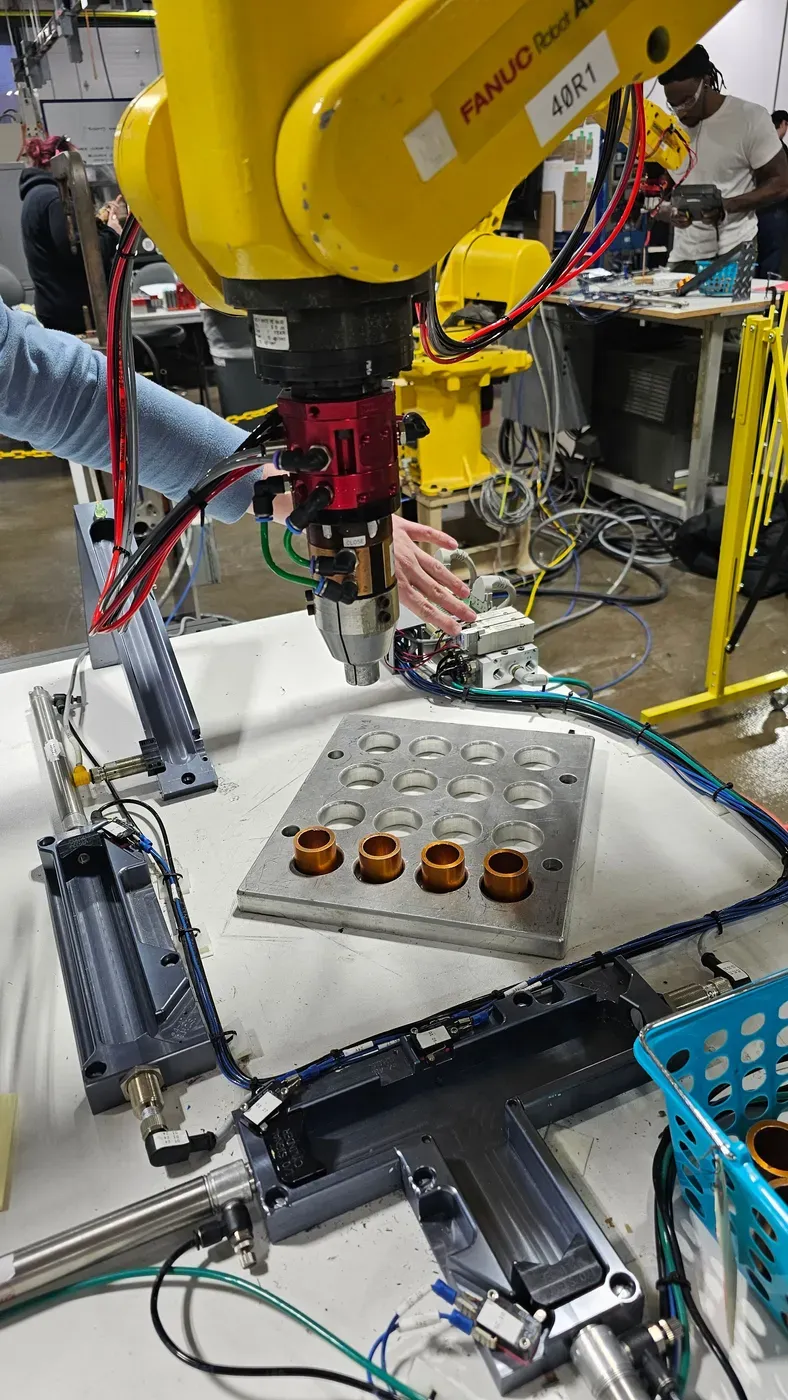
It did exactly what it was told. It did not pause to ask whether the path made sense, and it did not slow down as it approached the thing it was about to destroy.
That is the honest description of AI inside a lead generation system. If your targeting is wrong, it reaches the wrong people faster. If your follow-up sequence is irritating, it irritates more people per hour. And the components it damages first are the ones the whole machine depends on — your list, your domain’s sending reputation, and the willingness of your market to open anything from you again. Dry-run it before you point it at production.
Why AI Matters for Lead Generation Now
Most businesses do not have a traffic problem first. They have a system problem.
AI Helps You Move Faster
AI can speed up audience research, campaign ideation, content creation, follow-up, and testing. Instead of spending hours staring at a blank page or guessing at your next campaign, you can use AI to generate options, organize ideas, and launch faster.
AI Helps You Personalize at Scale
Personalization used to require a lot of manual work. Now AI can help tailor subject lines, landing page copy, nurture sequences, and outbound messaging based on role, industry, and behavior.
AI Helps You Prioritize Better Leads
Not every lead deserves the same level of attention. AI can analyze fit, intent, and engagement signals so your team focuses on leads most likely to buy.
AI Helps You Stop Posting and Praying
Random content rarely creates predictable pipeline. AI lets you build content around actual buyer questions, search intent, and measurable conversion paths.
The AI Lead Generation Flywheel
The simplest way to think about AI lead generation is as a flywheel:
- Research — Understand your ideal customer
- Attract — Create content, ads, and campaigns that earn attention
- Capture — Turn attention into subscribers, form fills, calls, or demos
- Qualify — Separate serious buyers from casual visitors
- Nurture — Follow up with relevant messages
- Convert — Help sales close the right leads
- Optimize — Use data to improve the whole system
Here’s the math behind it:
AI can improve every part of that equation, but the biggest wins usually come from lead quality, follow-up speed, and message relevance.
Follow-up speed is the term with the hardest evidence behind it. Across 1.25 million leads, firms that made contact within an hour were nearly seven times as likely to qualify the lead as those that waited even an hour longer (Harvard Business Review) — and unlike offer quality or positioning, response time is something automation genuinely can fix on its own.
10 Practical Ways to Use AI for Lead Generation
1. Use AI to Define Your Ideal Customer Profile
What it does: AI helps identify patterns in your best customers.
Why it matters: Without a clear ICP, every campaign is a gamble.
How to do it:
- Gather your top 10 best customers
- Gather your worst-fit customers
- Export CRM notes, call notes, testimonials, and analytics
- Ask AI to identify shared traits, pain points, buying triggers, and objections
Example prompt:
Analyze the following customer data and identify my highest-value customer segments. Look for shared traits, buying triggers, pain points, objections, and messaging angles. Then create three ideal customer profiles ranked by revenue potential and likelihood to convert.
Track: lead-to-customer conversion rate by segment, average deal size, sales cycle length
2. Use AI for Voice-of-Customer Research
What it does: AI mines reviews, comments, support tickets, and sales notes for real customer language.
Why it matters: Better messaging creates better leads.
If your copy sounds like a marketer wrote it, people ignore it. If it sounds like the conversation already happening in your buyer’s head, they pay attention.
How to do it:
- Collect testimonials, reviews, support tickets, and survey responses
- Feed them into AI
- Ask for pain phrases, desired outcomes, objections, and hook ideas
Track: landing page conversion rate, email open rate, reply rate
3. Use AI to Build a Content Strategy That Generates Leads
What it does: AI turns content from random activity into a pipeline asset.
I use a simple framework called the 4-Part AI Content-to-Lead System:
- Problem content — attracts people with pain
- Solution content — shows possible paths
- Proof content — builds trust
- Conversion content — drives opt-ins, calls, or demos
Example for a CRM consultant:
- Problem: “Why Your Leads Are Not Converting”
- Solution: “How to Use HubSpot for Lead Generation”
- Proof: “How We Increased Follow-Up Speed by 60%”
- Conversion: “Download the CRM Lead Scoring Template”
Track: organic leads, lead magnet opt-ins, content-assisted conversions
4. Use AI to Create Better Lead Magnets
What it does: AI helps create assets people actually want.
The best lead magnet solves a painful, urgent, specific problem your buyer already knows they have.
Strong formats include:
- Checklists
- Templates
- Calculators
- Scorecards
- Swipe files
- Prompt packs
- Mini-courses
Examples:
- AI Lead Generation Checklist
- Lead Scoring Spreadsheet
- 30-Day Content-to-Lead Calendar
- CRM Follow-Up Automation Template
Track: opt-in rate, cost per lead, lead-to-call conversion rate
5. Use AI Chatbots to Capture and Qualify Website Visitors
What it does: AI chatbots can answer questions, qualify leads, and route serious buyers.
A good chatbot feels like a helpful concierge, not a desperate salesperson.
The mechanics of setting one up — the qualification flow, the handoff to a human, and the mistakes that make visitors bounce — are covered in how chatbots can transform your lead generation strategy.
Useful qualification questions:
- What best describes your business?
- What are you trying to improve?
- How many leads do you generate per month?
- What is your biggest bottleneck?
- What is your budget?
- When do you want to solve this?
Track: chat engagement rate, qualified chats, meetings booked
6. Use AI for Predictive Lead Scoring
What it does: AI lead scoring estimates which leads are most likely to convert.
I like a simple model:
- Fit Score: Are they the right type of customer?
- Intent Score: Are they showing buying behavior?
- Engagement Score: Are they interacting with your brand?
A founder who visits your pricing page, downloads a checklist, and watches a demo should rank higher than someone who reads one blog post and disappears. Building the model itself — the fit criteria, the point values and the thresholds — is worked through in lead scoring: what it is and how to use it effectively.
Track: MQL to SQL rate, sales acceptance rate, close rate by lead score
7. Use AI to Personalize Cold Outreach
What it does: AI helps you personalize outbound messages without writing every email from scratch.
Important rule: AI-personalized spam is still spam.
The goal is not fake personalization. The goal is relevance.
Simple outreach structure:
- Relevant observation
- Specific problem
- Clear value proposition
- Low-friction CTA
Example:
Noticed you’re hiring SDRs and publishing more content around enterprise growth. Usually when that happens, lead quality and follow-up speed become the bottleneck. We help teams use AI to prioritize higher-intent leads before they hit sales. Worth comparing notes?
Track: reply rate, positive reply rate, meeting booking rate
8. Use AI to Automate Lead Nurturing
What it does: AI segments and follows up with leads based on behavior.
Most leads are not ready to buy on day one. AI helps you keep the conversation relevant without manually handling every touchpoint.
Example nurture sequence:
- Email 1: Deliver the lead magnet
- Email 2: Explain the framework
- Email 3: Share common mistakes
- Email 4: Show a real workflow or case example
- Email 5: Invite the lead to book a call
Track: click-through rate, lead-to-call conversion, time to booked call
9. Use AI to Improve Paid Ads
What it does: AI helps generate ad angles, test hooks, analyze audiences, and improve landing page alignment.
AI can accelerate testing, but it does not fix a bad offer. If the message, market, or offer is weak, AI will simply help you waste money faster.
Track: cost per lead, cost per qualified lead, landing page conversion rate, return on ad spend
10. Use AI to Analyze and Optimize the Entire Funnel
What it does: AI helps find bottlenecks faster than manual reporting.
Ask questions like:
- Which channel brings the best leads?
- Where are leads dropping off?
- Which content drives booked calls?
- Which nurture sequence creates sales conversations?
- Which segment has the best lifetime value?
Track:
- Visitors
- Leads
- Qualified leads
- Booked calls
- Show-up rate
- Close rate
- CAC
- Revenue per lead
- LTV
AI Lead Generation Tools by Category
The best AI lead generation tool depends on your business model, budget, sales cycle, and existing stack. Start with the workflow, then choose the tool.
- AI writing tools: ChatGPT, Claude, Jasper
- AI research tools: Perplexity, Gemini, browsing assistants
- CRM platforms: HubSpot, Salesforce, Zoho CRM
- Sales intelligence: Apollo, ZoomInfo, Clay, Clearbit
- Automation tools: Zapier, Make
- Chatbot tools: Intercom, Drift, HubSpot Chat, Tidio
- Email tools: ConvertKit, Mailchimp, ActiveCampaign
- Analytics tools: GA4, HubSpot Analytics, Looker Studio
How to Build an AI Lead Generation System in 30 Days
Days 1–5: Clarify Your ICP and Offer
- Export best customer data
- Identify top segments
- Summarize pain points with AI
- Clarify your core offer
- Define best-fit lead criteria
Days 6–10: Build Your Lead Magnet
- Brainstorm lead magnet ideas with AI
- Choose one urgent problem
- Create a checklist, template, or calculator
- Build a landing page
- Write delivery emails
Days 11–15: Create Your Content-to-Lead Plan
- Generate keyword clusters
- Build a 30-day content calendar
- Create problem, solution, proof, and conversion content
- Repurpose one long-form asset into short-form posts
- Add CTAs to every piece
Days 16–20: Set Up Lead Capture and Scoring
- Connect forms to your CRM
- Add source tracking
- Build scoring rules
- Segment leads by fit and intent
- Create alerts for high-intent actions
Days 21–25: Build AI-Assisted Follow-Up
- Write nurture emails
- Create sales follow-up templates
- Add behavior-based triggers
- Build re-engagement emails
- Personalize outreach with AI
Days 26–30: Analyze and Optimize
- Review traffic sources
- Measure opt-in rates
- Review lead quality
- Find funnel leaks
- Ask AI for optimization ideas
AI Prompts for Lead Generation
ICP Research Prompt
Act as a B2B lead generation strategist. Analyze the following customer data and identify the highest-value customer segments. Summarize their common traits, pain points, buying triggers, objections, and desired outcomes. Then recommend the top three segments I should target first.
Lead Magnet Prompt
Based on this ideal customer profile, generate 10 lead magnet ideas that solve urgent, specific problems. For each idea, include the target pain point, format, title, promise, and CTA.
Content Calendar Prompt
Create a 30-day content calendar for a business targeting [ICP]. Organize the content into four categories: problem-aware, solution-aware, proof-based, and conversion-focused. Include post topics, hooks, CTAs, and suggested lead magnet tie-ins.
Metrics to Track in AI Lead Generation
Do not judge AI lead generation by lead volume alone. More leads are not always better.
Be careful with borrowed benchmarks too, because AI makes them easy to chase. The widely quoted “respond within five minutes or your odds fall 100×” rule measures the odds of reaching someone, not the odds of closing them — an automation that hits every lead in ninety seconds has improved contact rate, which is worth having, and has told you nothing yet about revenue.
Focus on:
- Traffic by channel for attention quality
- Landing page conversion rate for offer strength
- MQL to SQL rate for lead quality
- Email click-through rate for nurture relevance
- Booked call rate for sales readiness
- Close rate for lead and sales effectiveness
- CAC and LTV for profitability
Common AI Lead Generation Mistakes to Avoid
- Automating before understanding the customer
- Using AI to create generic content
- Sending AI-written spam
- Ignoring lead quality
- Buying tools without a workflow
- Failing to review AI outputs
- Ignoring privacy and compliance
Bad inputs create bad outputs. Human review still matters for accuracy, brand voice, and compliance.
Is AI Lead Generation Legal and Ethical?
AI lead generation is generally legal when businesses follow privacy, consent, advertising, and communication laws. The risk comes from misusing personal data, sending unsolicited spam, making false claims, or failing to provide proper opt-out options.
Opt-out is the one with a hard number attached. Under the FTC’s CAN-SPAM guidance, an opt-out request must be honoured within 10 business days, and the right to opt out cannot be signed away or transferred — which matters more once AI is generating the sends, because volume is the thing that turns a process gap into a pattern of violations.
To stay safe:
- Use accurate data sources
- Respect consent rules
- Provide opt-out options
- Avoid deceptive personalization
- Review claims before publishing
- Follow CAN-SPAM, GDPR, CCPA, and other applicable regulations
Conclusion: AI Turns Lead Generation Into a System
AI lead generation works best when it improves an existing customer acquisition system rather than pretending to replace strategy. That is the real opportunity.
If you are tired of chasing leads, wasting money on underperforming campaigns, and relying on hope, start small. Define your ideal customer, create one strong lead magnet, connect it to your CRM, automate follow-up, and measure what happens.
That is how AI lead generation stops being hype and starts becoming a predictable leads in, money out system.
If you want one place to begin, pick the workflow you already run most often by hand and automate only that. One workflow, dry-run on ten records before it touches the list.
Frequently asked questions
Can ChatGPT do lead generation?
It can help with customer research, content, lead magnets, outreach drafts, chatbot scripts and follow-up sequences. It supports lead generation but does not replace strategy, distribution or sales execution.
What is the best AI tool for lead generation?
It depends on the job. Writing tools help with messaging, CRM tools manage tracking and scoring, sales intelligence tools support prospecting, and automation tools connect the workflow. Choose the workflow first.
How does AI improve lead quality?
By analysing fit, intent and engagement signals so a team can prioritise the leads most likely to buy instead of treating every lead the same.
Can AI replace human salespeople?
No. It can automate repetitive work and improve prioritisation, but trust, judgement, negotiation and relationship-building still require people.
What should I never hand to AI unreviewed?
Anything where being wrong is expensive: pricing claims, compliance or legal language, and any message going to a real person's inbox. AI is fastest at the tasks where a mistake is cheap to catch.
Is AI lead generation good for small businesses?
Yes, and especially so. Small teams get the most from it because it saves time, improves targeting and makes follow-up consistent without adding headcount.