
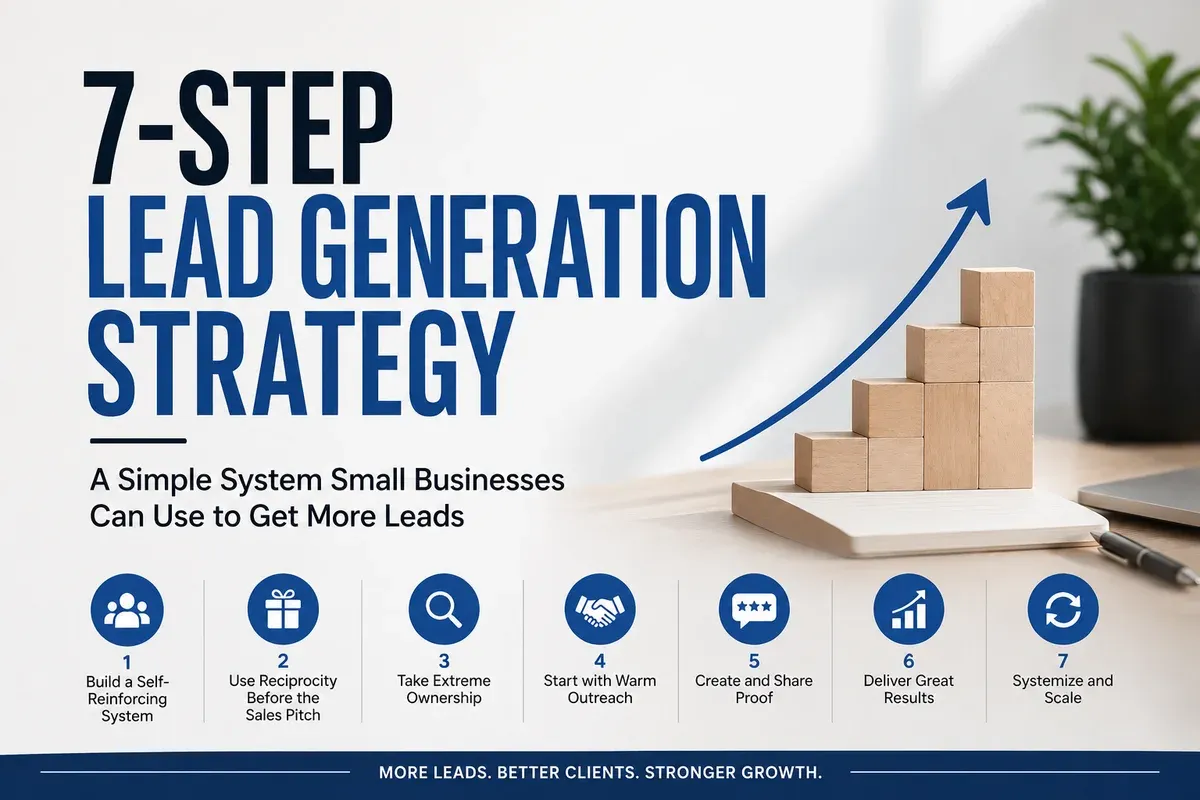
If you’re doing random marketing, posting when you feel like it, sending a few cold emails, and hoping leads magically appear, that’s usually why growth feels inconsistent.
Okay, so the fix is not just “work harder.” The fix is to build a lead generation system that compounds. In this guide, I’m going to break down the lead gen strategy Alex Hormozi is known for and show you how small businesses can actually use it without turning their week into a full-time chaos festival.
This is one specific approach. If you’re still deciding which channels to commit to in the first place, start with the wider guide to lead generation strategies and come back here once you know outreach is the lever you want to pull.
What is the Alex Hormozi lead generation strategy?
The Alex Hormozi lead generation strategy is a system for getting customers by combining great offers, direct outreach, proof, content, and referrals into one compounding machine.
What matters most is this: it’s not just about getting one lead. It’s about building a process where every customer helps you get the next one.
Who this is for
This is for:
- small businesses
- agencies
- consultants
- coaches
- service businesses
- founders trying to do more with less
This is not for:
- people looking for overnight magic
- businesses with a bad product and no intent to improve it
- anyone who wants leads without talking to humans, building proof, or following up
Step 1: Build a self-reinforcing lead generation system
The core idea is simple: don’t build a business that needs fresh effort for every single sale.
The way that it works is this:
- You get a customer
- You deliver a great result
- You ask for a review
- You ask for a referral
- That proof helps you close the next customer faster
This matters because word of mouth is still the most trusted channel there is — in Nielsen’s global Trust in Advertising study, 88% of consumers said they trust recommendations from people they know above every other form of marketing (Nielsen). If your system ends at “customer paid,” you’re stopping way too early.
What to do
- Add a review request into your delivery process
- Add a referral ask after a win
- Save testimonials in one place
- Reuse proof in sales, email, website copy, and content
Example
If you run a local plumbing company and close 20 jobs this month, but ask zero people for reviews, you wasted a ton of momentum. If even 8 of those customers leave reviews and 2 refer a friend, your future lead cost drops. And reviews are not a nice-to-have — 71% of consumers read online reviews regularly when browsing local businesses, and only 4% never read them (BrightLocal’s Local Consumer Review Survey).
Run the referral math on that plumber, too. Say a paid customer costs $400 to acquire. Referred customers cost roughly $0. If 2 of every 10 new customers come from referrals, your blended acquisition cost is 80% × $400 = $320 — a 20% discount on growth that repeats every month the loop keeps running. The formula is simple: blended cost = paid cost × (1 − referral share). Every point of referral rate you build is a point off your acquisition cost, forever.
Step 2: Use reciprocity before the sales pitch
A lot of businesses lead with, “Want to book a call?”
That’s usually too early. Reciprocity works better. Give value first, then ask.
In plain English: offer something useful that people normally pay for. When you help someone before demanding anything, trust goes up. Response rates usually do too.
About 15 years ago I started making tutorial videos for an automation tool called ScrapeBox. The developer was a one-man shop who didn’t want to be out on the internet, and he was burning hours answering the same questions over and over on public forums, so I made videos to take that off him. I wasn’t selling anything. But people started treating me as the expert, because I was the one teaching them, and for more than a decade after that I didn’t chase leads — partnerships, clients and opportunities came to me. My current business partner traces back to someone who reached out because of those videos.
That is reciprocity on a long timeline. The free thing you make to help someone else is often what builds the authority you cannot buy.
What to do
- Offer a free audit
- Offer a short personalized video
- Offer a free trial or limited test
- Offer a discounted starter package
- Give away practical advice that solves a real problem
Example offer angles
- “I’ll send you a 5-minute teardown of your lead funnel.”
- “I’ll show you 3 ways your website is losing conversions.”
- “We’ll set this up for you in 7 days so your team doesn’t have to figure it out.”
Step 3: Take extreme ownership of bad lead flow
If leads are weak, don’t blame the algorithm, the economy, or the tool first.
Right? Start with ownership.
That doesn’t mean outside factors never matter. They do. But the fastest path to improvement is assuming your message, your offer, your targeting, or your follow-up needs work.
Ask yourself
- Is my offer actually compelling?
- Am I targeting the right people?
- Am I giving enough proof?
- Am I following up enough?
- Am I asking for the sale too early?
- Am I tracking what’s working?
This matters because founders waste months switching platforms when the real issue is one broken step in the system. Same bad offer, different software. Still bad.
Step 4: Start with warm outreach before cold outreach
Warm outreach is one of the easiest ways to get early traction because you already have access to people who know you.
There’s probably gold in your phone, your Instagram followers, your LinkedIn connections, your email contacts, and past customers. Most people ignore that and jump straight into cold outreach because it feels more “scalable.” But warm outreach closes faster.
How do you do warm outreach?
Use a simple script:
- Start casual
- Ask about them
- Transition into the problem you solve
- Make a low-friction offer
- Ask for referrals or intros
Simple warm outreach script
Hey, how’s life? Quick question. Do you know anyone who needs help getting more qualified leads right now? I’m working with a few businesses and offering a discounted starter month in exchange for feedback, a review, and, if it goes well, a referral.
You can also make the ask direct:
Hey, quick question. Are you still handling your marketing in-house, or do you need help creating content and bringing in leads?
Best practices
- Track every conversation in a CRM, spreadsheet, or Notion
- Don’t “spray and pray”
- Follow up
- Make the offer specific
- Ask for a 3-way intro when it makes sense
Step 5: Fix your offer before scaling lead generation
Lead generation gets blamed for a lot of offer problems.
If the offer is weak, outreach won’t save it.
A strong offer usually has four parts — this is Hormozi’s value equation from $100M Offers:
- Dream outcome: what the customer wants
- Perceived likelihood: why they believe it will work
- Time delay: how fast they get results
- Effort and sacrifice: how easy it is for them
What makes an irresistible offer?
A good offer says:
- what result they get
- how soon they get it
- why they should believe you
- why it won’t be a pain
Example
Bad offer:
“We do digital marketing for local businesses.”
Better offer:
“We help plumbing companies book 20+ qualified jobs per month in 30 days without hiring an in-house marketing team.”
Another example:
“Get 30% more website conversions with an AI chatbot we build, train, and launch for you in 7 days.”
See the difference? Specific beats vague every time.
Step 6: Use cold outreach with personalization and fast value
Cold outreach works when it solves three problems:
- Who should I contact?
- What do I say?
- How do I get enough volume to matter?
The answer is targeted lists, personalized messaging, and automated follow-up.
How do you build a cold outreach system?
- Build a list of your ideal buyers
- Filter by industry, role, size, or revenue
- Personalize the first line
- Offer something useful
- Follow up automatically
- Track reply rates and opportunities
What to say
Don’t send this:
“We help businesses grow. Want to book a call?”
That’s lazy and everybody’s inbox has 47 versions of it already.
Send this instead:
- mention something relevant about their business
- describe a specific result you help create
- offer a free value asset
- keep the ask low friction
Example cold email structure
- Personalized opener
- Specific offer
- Brief proof
- Fast-value gift
- Simple CTA
Example
Hey John, noticed your company is growing fast in the construction space. We help construction firms generate more qualified inbound opportunities without adding admin overhead. Happy to send over a short personalized video showing 3 places your current lead flow may be leaking if that helps.
That works better because it gives before it asks.
Step 7: Use content as trust-building fuel
Content is not just for views. It’s trust at scale.
When people see your outreach, referral, or ad, a lot of them will check your website and social channels. They want to know if you’re legit.
That’s where content helps you. Use three buckets:
Short-form content
Best for awareness.
Use it to:
- share quick wins
- challenge bad assumptions
- hook attention
- speak to top-of-funnel pain points
Long-form content
Best for trust and education.
Use it to:
- explain your process
- teach your strategy
- answer objections
- demonstrate expertise
Long-form content is where people really get convinced. I don’t know, right, but a 30-second clip can get attention while a deeper piece is what helps close the trust gap.
Pre-sell content
Best for bottom of the funnel.
Create content that answers objections like:
- Why should I trust you?
- How long does this take?
- What if this doesn’t work for my business?
- How much effort is required from my team?
If you know prospects always stalk your social before replying, pre-sell them there.
Common mistakes people make with this strategy
The biggest mistakes are usually pretty predictable.
- Relying only on cold outreach and ignoring warm leads
- Having a weak offer and blaming lead gen
- Not asking for reviews or referrals
- Posting content with no strategy
- Not tracking outreach activity
- Giving up too early because volume feels uncomfortable
- Treating customers like one-time transactions
Avoid linear growth thinking too. If your whole lead system depends on you manually doing everything every day, it will eventually bottleneck.
Frequently asked questions
Does this lead generation strategy work for small businesses?
Yes. In fact, it's especially useful for small businesses because it focuses on leverage. Warm outreach, referrals, proof, and content are all channels that can help you do more with less.
What should I do first: warm outreach or cold outreach?
Start with warm outreach. It's faster, cheaper, and easier to test your message. Once your offer and script work, layer in cold outreach.
How important are reviews in lead generation?
Very important. Reviews increase trust, improve conversion rates, strengthen your sales process, and create a self-reinforcing growth loop.
What if I'm not getting replies from cold outreach?
Check targeting, offer strength, personalization, and volume. Most people either contact the wrong list, make the ask too big, or stop before they have enough data.
How does content help lead generation?
Content builds trust before the call. It helps prospects understand your expertise, handle objections, and feel more confident saying yes.
Can AI help with this process?
Yes. AI can help you write offers, generate outreach variations, personalize first lines, organize CRM notes, and brainstorm content angles. Just don't let it turn your messaging into generic robot soup.
Next steps
If you only do three things after reading this, do these:
- Reach out to 20 warm contacts this week
- Rewrite your offer so it’s specific, fast, and easy to understand
- Build a review and referral system into your client delivery
If you want the order I’d do this in:
- Fix your offer
- Start warm outreach
- Collect proof
- Launch cold outreach
- Create content that supports the whole funnel
- Track everything
- Refine based on results
Final takeaways
The real lesson here is that lead generation is not one tactic. It’s a system.
You need a strong offer. You need warm outreach. You need cold outreach that actually gives value. You need content that builds trust. And you need a process that turns customers into proof, because that proof makes the next sale easier.
Okay, so if your goal is to build a business that compounds instead of one that constantly resets to zero, this is the play: get high-quality leads, treat customers really well, and turn every win into more trust.
That’s how you build momentum.