
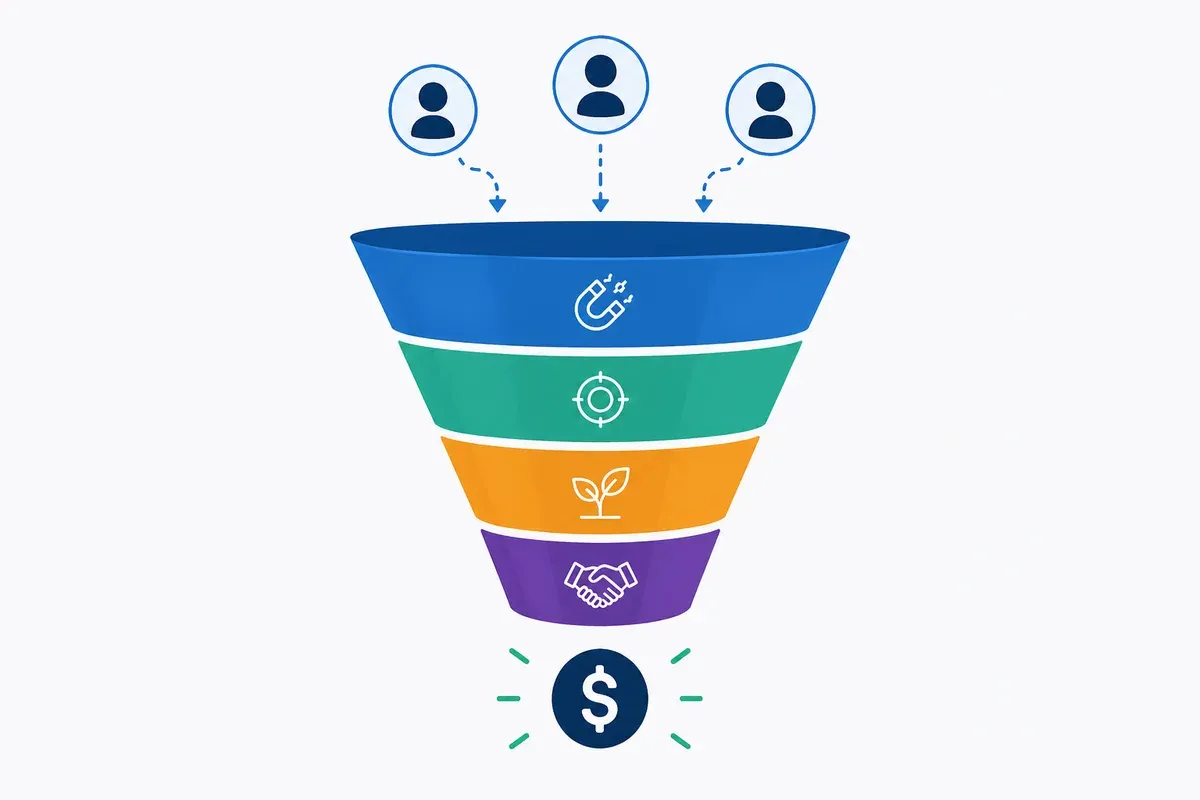
If your business still depends on referrals, random content, or ads that may or may not work, you do not have a lead generation system yet. You have lead generation luck.
Okay, so that might sound a little blunt, but it’s true. Lead generation mastery is what turns marketing from a stressful guessing game into a repeatable process that helps you attract qualified leads, turn them into sales opportunities, and grow without feeling like you’re reinventing the wheel every month.
This guide is about building the system itself. If you are earlier than that and still weighing up which channels deserve your time, the wider guide to lead generation strategies covers the ten that actually work and how to choose between them.
What is lead generation mastery?
Lead generation mastery is the strategic skill of turning attention into interest, interest into qualified leads, and qualified leads into revenue through a repeatable and measurable system.
Lead generation itself is the process of attracting potential customers and getting some kind of signal from them, like contact information, a booked call, a demo request, or clear buying intent. Mastery means that process stops being random.
The way that it works is simple: you create clear inputs, track outputs, and improve what is not working. That means your marketing, offer, sales process, follow-up, and analytics all need to connect.
| Basic lead generation | Lead generation mastery |
|---|---|
| Random campaigns | Repeatable system |
| Focuses on more leads | Focuses on qualified leads |
| Tracks vanity metrics | Tracks revenue metrics |
| Depends on referrals or luck | Uses diversified channels |
| One-off tactics | Continuous optimization |
| Weak follow-up | Structured nurturing |
| Unclear ROI | Clear pipeline math |
A lot of entrepreneurs are not short on effort. They are short on structure. Right? That’s the gap lead generation mastery solves.
Why does lead generation matter for entrepreneurs?
Lead generation matters because every sale starts as a lead. For entrepreneurs, a reliable lead generation system creates predictable opportunities, improves cash flow, reduces dependence on referrals, and makes business growth easier to manage.
Lead generation is not just a marketing function. It is the front end of your revenue engine.
Without leads, even a great offer cannot grow. And if your only lead source is referrals, you’re basically building your business on someone else remembering to mention you at lunch.
| If lead generation is weak | If lead generation is strong |
|---|---|
| Revenue fluctuates | Revenue becomes more predictable |
| Sales feel stressful | Sales become more systematic |
| Ads feel risky | Marketing becomes measurable |
| Referrals become a crutch | Referrals become one channel among many |
| Growth feels chaotic | Growth becomes intentional |
| Founder feels reactive | Founder feels in control |
Strong lead flow gives you options. You can plan hiring, test offers, improve margins, and make smarter decisions because you’re not operating in survival mode all the time.
What is the Lead Machine Framework?
The seven parts of lead generation mastery are market, message, offer, traffic, capture, nurture, and conversion. Entrepreneurs need all seven working together to create predictable lead flow.
I call this the Lead Machine Framework. It keeps things simple and shows you where the leak actually is.
| Stage | Question it answers | Example |
|---|---|---|
| Market | Who is the right customer? | Small business owners doing $20k to $100k per month |
| Message | What pain or desire do they care about? | “Stop relying on referrals for growth” |
| Offer | Why should they act now? | Free lead generation audit |
| Traffic | Where will they find you? | SEO, LinkedIn, referrals, paid ads |
| Capture | How do they enter your pipeline? | Landing page, form, calendar booking |
| Nurture | How do you build trust? | Email sequence, retargeting, case studies |
| Conversion | How do they become a buyer? | Sales call, proposal, checkout, demo |
If one part is weak, the whole system struggles. More traffic won’t fix a bad offer. Better copy won’t fix the wrong audience. More content won’t fix missing follow-up.
How do you build a lead generation system? The 8 steps
The eight steps build out the Lead Machine Framework in order — each step makes the next one easier.
Step 1: Define your ideal customer before you chase leads
If you try to generate leads from everyone, you usually convert no one.
Most lead generation problems start with weak targeting. You need an ideal customer profile before you choose channels, create content, or spend money on ads.
Ask these questions:
- Who has the problem we solve?
- Who already pays to solve this problem?
- Who gets the fastest result from our offer?
- Who has buying power?
- Who has urgency?
- Who is easiest to reach?
- Who is most profitable to serve?
Here’s a simple ICP example:
| Field | Example |
|---|---|
| Business type | B2B service business |
| Revenue range | $20k to $100k per month |
| Pain | Inconsistent qualified leads |
| Desired outcome | Predictable sales pipeline |
| Buying trigger | Referrals slowing down |
| Decision maker | Founder or owner |
| Best channel | LinkedIn, SEO, email, partnerships |
Do this first. Otherwise your message gets fuzzy, your content gets generic, and your sales calls fill up with people who were never going to buy.
Step 2: Create an offer that makes lead generation easier
A strong lead generation offer gives prospects a clear reason to take the next step.
Lead generation does not fix a weak offer. It just exposes it faster.
A clear offer improves clicks, conversion rates, referrals, and sales calls because people instantly understand the value. Good lead generation offers include:
- Free audits
- Strategy calls
- Lead magnets
- Webinars
- Demos
- Trials
- Assessments
- Calculators
- Checklists
- Templates
- Workshops
Use these questions to evaluate your offer:
- Is the outcome clear?
- Is the value obvious?
- Is the next step simple?
- Does it solve a real pain?
- Does it attract buyers instead of freebie hunters?
- Does it naturally lead to the paid offer?
A weak offer says:
“Subscribe to our newsletter.”
A stronger offer says:
“Get a free 15-minute lead generation audit and discover the three biggest leaks in your funnel.”
See the difference? One asks for attention. The other promises value.
Step 3: Build a lead magnet that attracts buyers, not browsers
The best lead magnets solve a specific problem for a specific audience and create a fast win.
A lead magnet should not just collect emails. It should attract the kind of person who could actually become a customer.
A strong formula is:
Specific Audience + Specific Problem + Fast Win
Example:
“Free Content-to-Leads Checklist for B2B Founders Who Are Tired of Posting Without Results”
Here are a few ideas:
| Business type | Lead magnet idea |
|---|---|
| Marketing agency | Lead generation audit checklist |
| Consultant | Revenue leak assessment |
| E-commerce brand | Product recommendation quiz |
| SaaS startup | ROI calculator |
| Coach | 7-day client acquisition plan |
| Content creator | Content calendar template |
| Local service business | Cost savings estimate |
| B2B service provider | Buyer readiness scorecard |
The goal is not to impress people with a 97-page PDF nobody reads. The goal is to help them get a quick result and want the next step.
Step 4: Choose the right lead generation channels
The best lead generation channels depend on where your ideal customer already pays attention and how they prefer to buy.
There is no universal best channel. I don’t know, people love asking, “What’s the best lead source?” The honest answer is: it depends.
Here’s a useful breakdown:
| Channel type | Examples | Best for |
|---|---|---|
| Owned | Website, email list, blog, podcast | Long-term authority and trust |
| Earned | SEO, PR, referrals, organic social | Cost-efficient credibility |
| Paid | Google Ads, Meta Ads, LinkedIn Ads, retargeting | Faster testing and demand capture |
| Direct | Cold email, LinkedIn outreach, networking | Targeted B2B prospecting |
| Partner | Referral partners, affiliates, co-marketing | Borrowed trust |
And by business model:
| Business model | Recommended starting channels |
|---|---|
| B2B consulting | LinkedIn, referrals, SEO, webinars |
| Agency | SEO, case studies, outbound, partnerships |
| E-commerce | Paid social, influencer content, email, SEO |
| SaaS | SEO, free tools, demos, webinars, paid search |
| Local service | Local SEO, Google Business Profile, referrals, PPC |
| Personal brand | Social content, newsletter, podcast, lead magnets |
Start with one or two channels, not seven. Mastery comes from focus, not channel collecting.
Step 5: Use content marketing to turn strangers into leads
Content works best when each piece has a job inside your funnel.
A lot of businesses create content for attention but forget the conversion path. If your content educates people but never gives them a next step, it behaves like a hobby.
Here’s the content-to-lead path:
- A prospect finds your content
- The content addresses a real problem
- Trust starts building
- The CTA offers a useful next step
- The prospect opts in
- Email or retargeting nurtures them
- A sales opportunity gets created
Use content by funnel stage:
| Funnel stage | Content type | Goal |
|---|---|---|
| Awareness | How-to articles, short videos, social posts | Attract attention |
| Consideration | Guides, case studies, webinars | Build trust |
| Decision | Comparisons, demos, audits, testimonials | Create action |
| Retention | Email, customer education, community | Increase lifetime value |
I like the simple Hook, Retain, Reward model.
- Hook: Start with pain, desire, or curiosity
- Retain: Give practical value and clarity
- Reward: Offer a useful next step
That next step might be a checklist, audit, webinar, calculator, or call.
Step 6: Capture leads with landing pages, forms, and clear CTAs
Traffic without capture is wasted attention.
Every campaign needs a destination. And no, your homepage is usually not that destination.
A strong landing page should include:
- A clear headline
- A specific promise
- Who it is for
- Benefits
- Proof
- A simple form
- A strong CTA
- Trust signals
- No unnecessary distractions
A good CTA looks like this:
“Get My Free Lead Generation Audit”
For top-of-funnel offers, keep forms short:
- Name
- Business website
For higher-intent offers, ask more:
- Revenue range
- Biggest challenge
- Current lead source
- Monthly lead volume
- Phone number
Choose the form length based on intent. Lower friction for colder traffic. More qualification for warmer prospects.
Step 7: Nurture leads until they are ready to buy
Lead nurturing is how you build trust after someone enters your pipeline.
Most leads are not ready to buy immediately. That’s normal. If you treat every lead like they should purchase on day one, you’ll waste a lot of opportunities.
Email marketing is one of the most reliable lead nurturing tools because it lets you educate, handle objections, and stay top of mind. It also earns its keep: marketers average $36 back for every $1 spent on email (Litmus) — a better return than any other channel. A simple nurture sequence might look like this:
| Purpose | |
|---|---|
| Email 1 | Deliver the lead magnet |
| Email 2 | Identify the core problem |
| Email 3 | Share proof or a case study |
| Email 4 | Teach a useful framework |
| Email 5 | Address objections |
| Email 6 | Invite them to book a call or demo |
| Email 7 | Add urgency or suggest a next step |
You can also use retargeting, SMS, webinars, and sales follow-up. Speed-to-lead matters a lot for high-intent inquiries: research published in Harvard Business Review found that firms contacting a lead within an hour were nearly seven times more likely to qualify that lead than firms that waited even sixty minutes longer. If someone requests a demo and hears from you three days later, that lead is already emotionally dating somebody else.
Step 8: Convert leads into customers with a simple sales process
Lead generation is incomplete without conversion.
You need a repeatable sales process so leads do not die in the handoff between marketing and sales.
A simple process looks like this:
- Lead enters the pipeline
- Lead is qualified
- Discovery call or demo happens
- Pain and outcome are clarified
- Offer is presented
- Objections are handled
- Decision is made
- Follow-up continues if needed
Use basic qualification criteria:
- Need: Do they actually have the problem?
- Fit: Are they the right type of customer?
- Authority: Can they make the decision?
- Budget: Can they afford the solution?
- Timeline: Do they want to act soon?
This is where MQLs and SQLs matter. A marketing qualified lead is interested. A sales qualified lead is ready for a deeper conversation. If your team treats those as the same thing, your pipeline gets messy fast.
The lead generation math entrepreneurs need to know
Revenue = Traffic × Lead Conversion Rate × Sales Conversion Rate × Average Customer Value
This is the part people skip, and it’s the part that makes everything calmer. Lead generation feels less emotional when you can see the math.
Track these metrics:
| Metric | What it means | Why it matters |
|---|---|---|
| Website traffic | Number of visitors | Measures attention |
| Conversion rate | Percent who become leads | Measures page and offer quality |
| Cost per lead | Cost to generate one lead | Measures acquisition efficiency |
| Lead-to-call rate | Percent who book a call | Measures intent |
| Close rate | Percent who buy | Measures sales effectiveness |
| CAC | Cost to acquire a customer | Measures profitability |
| LTV | Lifetime value | Shows what you can afford to spend |
| Payback period | Time to recover CAC | Helps with cash flow |
Example:
- 1,000 monthly visitors
- 5% convert to leads
- 20% book a call
- 30% close
- $3,000 average customer value
That gives you:
- 50 leads
- 10 calls
- 3 customers
- $9,000 revenue
Now you can improve one variable at a time. That’s lead generation mastery. Not vibes. Math.
And here’s the part almost nobody runs the numbers on — the variables multiply, so small improvements compound. Take that same funnel and improve each conversion stage by just 20% (5% → 6% lead conversion, 20% → 24% booking, 30% → 36% close):
| Scenario | Leads | Calls | Customers | Revenue | vs. base |
|---|---|---|---|---|---|
| Base funnel | 50 | 10 | 3 | $9,000 | — |
| +20% lead conversion only | 60 | 12 | 3.6 | $10,800 | +20% |
| +20% on all three stages | 60 | 14.4 | 5.2 | $15,552 | +73% |
| Double the traffic instead | 100 | 20 | 6 | $18,000 | +100% |
Three 20% improvements — none of them heroic — compound to 73% more revenue with zero new traffic. Doubling traffic beats it on paper, but you pay for every one of those extra visitors, while conversion improvements are mostly one-time fixes you keep forever. That is why “we need more leads” is usually the most expensive sentence in marketing.
What are the best lead generation strategies for entrepreneurs?
The best lead generation strategies for entrepreneurs include SEO, content marketing, LinkedIn, referral partnerships, webinars, lead magnets, email nurturing, paid search, paid social, case studies, free tools, and direct outreach.
Here are the best starting points:
SEO and content marketing
Best for long-term compounding traffic. Great when your audience is already searching for answers and solutions — organic search drives about 53% of all trackable website traffic (BrightEdge), more than any other channel.
LinkedIn content and outreach
Best for B2B consultants, agencies, coaches, and service providers. It combines authority with direct relationship building.
Referral partnerships
Best for service businesses and trust-heavy offers. Complementary businesses can send warm leads faster than cold channels.
Webinars and workshops
Best for high-ticket or more complex offers. Teaching builds trust at scale and pre-qualifies buyers.
Lead magnets and email sequences
Best for turning anonymous traffic into owned audience. This is how you stay in touch with people who are not ready yet.
Paid search
Best for capturing existing buying intent. Works well when demand already exists and you have good landing pages.
Paid social
Best for awareness, retargeting, and offer testing. Usually requires stronger creative and more testing.
Case studies
Best for proving real results. Especially helpful at the bottom of the funnel.
Free tools and calculators
Best for SaaS, consultants, agencies, and financial services. These can attract links, shares, and highly qualified leads.
Direct outreach
Best when your target market is clearly defined. Personalization matters. Spam is not a strategy, whatever people on the internet say. For a full step-by-step playbook covering warm and cold outreach, see the 7-step Hormozi-style lead generation strategy.
What mistakes keep entrepreneurs stuck?
If your lead generation feels unpredictable, do not add more tactics first. Find the leak in the system.
When we bought our house, it came with a dishwasher that had a plastic tower inside that kept popping off mid-cycle. You never found out until the cycle finished and every dish was still dirty. So we taped it, and that worked for a while. We hit it with a heat gun, and that worked for a while. The replacement part was $200 on a dishwasher that cost $300 new, so I refused to pay it — and I never had the few hours it takes to sit down and research a new one. Three months of that went by before the whole machine died and we finally did the thing we should have done on day one.
Most stuck lead generation looks exactly like that. It is rarely a missing tactic. It is a patch nobody has stopped to replace.
The most common mistakes are:
- Posting without a strategy
- Running ads before fixing the offer
- Sending traffic to a weak landing page
- Targeting everyone
- Measuring likes instead of leads
- Buying low-quality leads
- Ignoring follow-up
- Relying only on referrals
- Switching channels too quickly
- Not using a CRM
- Not tracking conversion rates
- Creating content without CTAs
- Confusing traffic with demand
- Failing to define a qualified lead
Here’s a quick diagnostic table, mapped to the Lead Machine Framework stages:
| Symptom | Likely problem | Fix |
|---|---|---|
| Lots of traffic, few leads | Weak offer or landing page | Improve CTA and lead magnet |
| Lots of leads, few calls | Poor qualification or nurture | Add segmentation and follow-up |
| Lots of calls, few sales | Sales process issue | Improve discovery and offer |
| Ads not converting | Targeting, offer, or page mismatch | Test message and landing page |
| Content gets engagement but no leads | No conversion path | Add CTA and opt-in |
| Referrals are slowing down | No scalable channel | Add SEO, outreach, or partnerships |
How long does lead generation take?
Lead generation can take days, weeks, or months depending on the channel.
Paid ads and outbound can create leads quickly. SEO and content usually take longer, but they compound. Referral partnerships are relationship-based, so they depend on trust.
| Channel | Typical timeline | Notes |
|---|---|---|
| Paid search | Days to weeks | Fastest if demand exists |
| Paid social | Weeks to months | Needs creative testing |
| Cold outreach | Days to weeks | Works best with strong targeting |
| LinkedIn organic | 1 to 3 months | Consistency matters |
| SEO | 3 to 12 months | Slower start, stronger compounding |
| Webinars | 2 to 8 weeks | Depends on promotion |
| Referral partners | 1 to 6 months | Built on trust |
| Email nurture | 2 to 12 weeks | Depends on list quality |
How can AI help with lead generation?
AI can help with lead generation by improving research, content creation, outreach personalization, lead scoring, analytics, and automation.
AI can help you:
- Research customer pain points
- Draft content outlines
- Create email sequences
- Personalize outreach
- Summarize sales calls
- Score leads
- Analyze campaign performance
- Generate ad variations
- Repurpose content
- Build simple website assistants
Small businesses can use AI to do more with less, but only if the business owner knows what outcome they’re trying to create.
A 30-60-90 day lead generation mastery plan
A 90-day lead generation plan should focus on foundation first, traffic and testing second, and optimization third.
First 30 days: build the foundation
- Define your ideal customer profile
- Clarify your core offer
- Choose one primary channel
- Create one lead magnet or conversion offer
- Build a landing page
- Set up a CRM
- Install analytics
- Write a basic email sequence
- Define a qualified lead
Days 31 to 60: drive traffic and test messaging
- Publish content consistently
- Run small paid tests if budget allows
- Start outreach or referral partner conversations
- Test 2 to 3 headlines or CTAs
- Track conversion rates
- Review lead quality
- Create one case study
- Improve the landing page
Days 61 to 90: optimize and scale
- Double down on the best-performing channel
- Improve nurture emails
- Add retargeting if relevant
- Build referral relationships
- Create content around objections
- Review close rates
- Calculate cost per lead and CAC
- Create a monthly dashboard
Lead generation mastery checklist
- I know exactly who my ideal customer is
- I have a clear offer
- I have a lead magnet or conversion offer
- I have a focused landing page
- I have one primary traffic channel
- I have a lead capture form
- I have a CRM
- I have an email follow-up sequence
- I have a sales process
- I track conversion rates
- I know my cost per lead
- I know my customer acquisition cost
- I know my average customer value
- I review performance weekly
- I have at least one backup lead source
- I am building owned audience assets
- I have proof assets like testimonials or case studies
- I have a referral strategy
- I know where leads are dropping off
- I improve the system every month
Frequently asked questions about lead generation mastery
What is lead generation mastery?
Lead generation mastery is the ability to consistently attract, capture, nurture, and convert qualified prospects through a repeatable system. It replaces random marketing with predictable opportunities.
What is the Lead Machine Framework?
The Lead Machine Framework is a seven-part model for diagnosing lead generation: market, message, offer, traffic, capture, nurture, and conversion. Growth is capped by the weakest part, so you find the earliest broken stage and fix that first.
What is the best lead generation strategy for entrepreneurs?
The best strategy depends on your audience, business model, and offer. For many entrepreneurs, strong starting points are SEO, referrals, LinkedIn, email marketing, webinars, and outreach.
Why is lead generation so hard?
Lead generation is hard when targeting, messaging, offers, channels, and follow-up are disconnected. Most businesses do not need more tactics first. They need a complete system.
How do I generate leads with content marketing?
Create content around real customer problems, add a clear CTA, offer a useful lead magnet, and nurture people through email or retargeting until they are ready to buy.
Should I buy leads for my business?
Usually no. Purchased leads are often low quality, poorly qualified, or shared with competitors. Building your own lead sources tends to create stronger long-term results.
Can AI generate leads?
AI can support lead generation, but it works best as an assistant. It can improve speed, personalization, and efficiency, but it still needs human strategy and oversight.
Final takeaways
Lead generation mastery is not about chasing every new tactic, platform, or hack. It is about building a system that turns attention into trust, trust into leads, and leads into revenue.
If you only do three things from this guide, do these:
- Define your ideal customer clearly
- Create one strong offer with one clear CTA
- Track the math from traffic to customer
When your lead generation system works, marketing stops feeling like a gamble. You know where leads come from, what they cost, how they convert, and what to do next.
If you want the fastest way to spot weak points in your funnel, start with the lead generation mastery checklist above and review your system against the seven Lead Machine Framework stages. That alone will help you see whether the real issue is market, message, offer, traffic, capture, nurture, or conversion.